As an Amazon Associate, we earn from qualifying purchases. Some links on this site are affiliate links at no extra cost to you. Our recommendations are based on thorough research and editorial judgment.


How Do Curved Rebounders Compare To Flat Rebounder Nets?

Curved rebounders feature adjustable angles and unpredictable ball returns, enhancing training versatility for athletes. Their heavy-duty frames and weather-resistant netting offer durability. In contrast, flat rebounder nets provide a consistent, predictable bounce, making them ideal for skill refinement. Constructed with heavy-duty materials, they guarantee stability and reliability. Although curved designs may require more maintenance, each option serves distinct training goals. Understanding these differences can assist in selecting the right rebounder to optimize performance. Further details follow.
Key Takeaways
- Curved rebounders provide unpredictable bounce angles for dynamic training, while flat nets ensure consistent ball returns for refining specific skills.
- Adjustable settings on curved rebounders enhance versatility, while flat rebounders focus on controlled practice for improving hand-eye coordination.
- Durability in curved rebounders relies on high-quality materials, whereas flat rebounders prioritize heavy-duty construction and rust resistance.
- Maintenance for curved designs is more demanding, potentially increasing long-term costs compared to the simpler upkeep of flat rebounders.
- Training objectives influence the choice of rebounder, as curved models encourage diverse drills while flat nets support specialized skill development.
Design Features of Curved Rebounders
Curved rebounders possess unique design features that enhance training effectiveness for various sports. Their curved net design provides different rebound angles, allowing for unpredictable ball returns that facilitate unique training experiences. Adjustable angles enable players to practice a variety of skills, such as catching and throwing, tailored to specific needs. Heavy-duty steel frames guarantee stability during high-impact training, while UV-resistant netting offers durability against weather conditions. These features combine to create realistic deflections, simulating game scenarios. Furthermore, lightweight and foldable designs enhance portability, making them easy to transport and store for individual or team practice sessions. Overall, the adaptability and robust construction of curved rebounders present substantial advantages for athletes looking to improve their performance. Additionally, the training versatility offered by Adjustable angles allows athletes to engage in various drills, improving overall skill proficiency.
Structural Characteristics of Flat Rebounder Nets
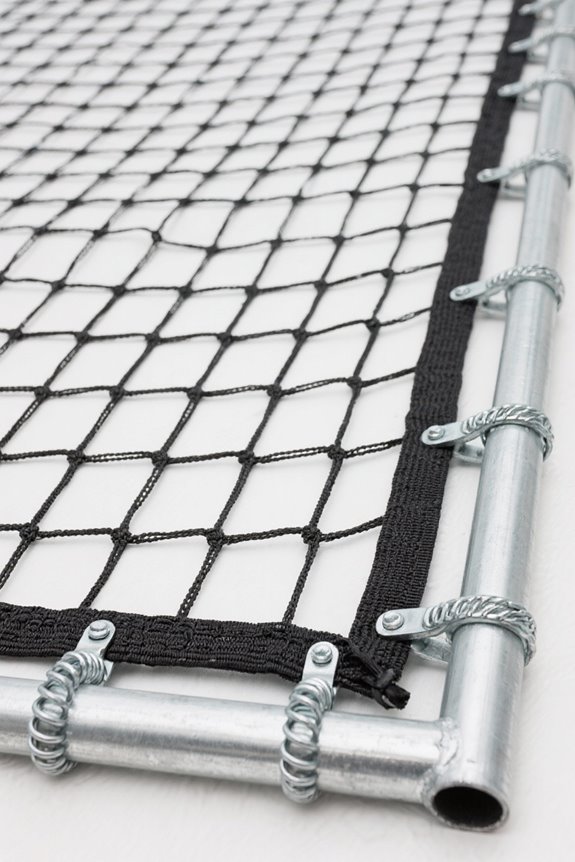
Flat rebounder nets are constructed with a focus on durability and stability, utilizing heavy-duty materials such as steel or aluminum for their frames. These frames typically adopt rectangular or square designs, making them straightforward to set up and transport. Often powder-coated, the frame construction offers added protection against corrosion. The nets themselves feature netting types made from durable polyethylene (PE) or nylon, which assure consistent rebound performance. Proper tensioning of the net is essential for ideal bounce and impact resistance. Additionally, many flat rebounder nets feature UV-resistant materials, prolonging their lifespan against sun damage. Overall, the combination of robust frame materials and durable netting types guarantees that flat rebounder nets can withstand rigorous training sessions, catering to various skill levels. Moreover, features like color-coded scoring zones found in some training nets enhance skill development during practice.
Ball Return Dynamics of Curved Rebounders

Training tools designed for athletes can markedly influence skill development. Curved rebounders introduce significant ball response variability compared to flat nets, altering the return path of the ball. This curvature generates unpredictable bounce angles, allowing for a variety of speeds and directions that mirror real-game scenarios. Athletes benefit from enhanced training effectiveness, as these varied returns demand quick adjustments, improving reaction times and adaptability. Different impact locations along the curve lead to both vertical and lateral ball returns, increasing the versatility of drills. Coaches can simulate challenging situations without needing multiple players, promoting the development of essential skills such as hand-eye coordination and reflexes. Overall, the dynamic nature of curved rebounders prepares athletes for the complexities of competitive play. Additionally, the use of adjustable angles allows trainers to cater drills to specific skills, further enhancing the training experience.
Consistency in Ball Returns With Flat Rebounders

For athletes seeking reliable performance, flat rebounder nets provide a consistent ball return that greatly enhances skill development sessions. These rebounders feature a taut, uniform surface that guarantees predictable return angles with minimized variance in rebound distance. This allows athletes to focus on practice consistency during drills for ball reception and passing. The even tension across the net surface aids in creating stable rebounds, making it easier for athletes to anticipate the ball’s trajectory. While flat rebounders lack a “sweet spot,” which can lead to less reliable bounces, they excel in delivering consistent returns essential for skill refinement. Overall, these rebounders facilitate effective solo training, promoting confidence and improving hand-eye coordination through repetitive practice. Additionally, using high-visibility colors in training aids players in maintaining awareness during drills.
Adjustable Settings in Curved Rebounders

Curved rebounders offer adjustable settings that greatly enhance training versatility for athletes. Typically featuring 5 to 7 angle settings, these devices allow users to modify the rebound trajectory and tilt, simulating various real-game scenarios. This angle versatility enables athletes to practice ground passes and volleys by changing the ball return direction and intensity. Moreover, some curved rebounders include adjustable tension systems, using bungee cords to accommodate different users. Tension adaptability alters the firmness of the rebound surface, providing a customized bounce responsiveness suitable for various fitness levels. By allowing precise adjustments in both angle and tension, curved rebounders support tailored practice sessions that improve anticipation, ball control, and overall skills essential for competitive sports. Additionally, the inclusion of adjustable angles enhances the training experience, allowing players to refine their techniques in multiple scenarios.
Limited Adjustability in Flat Rebounders
While flat rebounders provide a straightforward training solution with a consistent ball return, their limited adjustability poses significant drawbacks for athletes seeking a thorough practice experience. These rebounders typically have a fixed angle, restricting the variety of drills a player can perform, which negatively impacts training efficiency. Users may find their workouts less engaging due to repetitive scenarios, as flat rebounders do not accommodate diverse ball trajectories or varying shot types. Additionally, limited adaptability may hinder skill development, thereby reducing the overall value for players, particularly those at advanced levels. Although flat rebounders can be portable and budget-friendly, their static nature fails to meet the dynamic training needs of athletes aspiring for progression in their skills and techniques. Using equipment with high-quality materials ensures better performance and longevity, making it a more effective choice for serious training.
Training Versatility Offered by Curved Rebounders
Offering a notable edge in training versatility, curved rebounders enhance athlete development through their unique design and functionality. These devices provide improved multi-angle rebounds, which allow athletes to practice adaptive strategies by receiving passes from various angles. This unpredictability increases training efficiency, as it better mimics real in-game scenarios, requiring athletes to adjust their positions adeptly. The curvature of the nets accommodates diverse shot types, supporting complex drills that combine power, precision, and ball control. Additionally, curved rebounders facilitate innovative drills for footwork, passing, and defensive maneuvers, promoting a thorough skill set. Overall, their design creates a dynamic training environment, ensuring athletes remain engaged and continually challenged, greatly improving their performance on the field or court. Incorporating training equipment such as scoring targets can further enhance the effectiveness of drills performed with curved rebounders.
Focused Practice Opportunities With Flat Rebounders
Focused practice on flat rebounders provides athletes with opportunities to refine specific skills in a controlled environment. This consistent surface supports improved cardiovascular fitness, muscle strength, and enhanced balance, vital for injury prevention. Athletes can tailor workouts to achieve varying intensity levels, increasing the effectiveness of their focused practice sessions. The flat rebounder also promotes exercise variety, allowing users to engage multiple muscle groups simultaneously, thereby creating a thorough workout experience. Additionally, bouncing on a flat surface stimulates the lymphatic system, contributing to detoxification and immune function. Overall, utilizing flat rebounders enables athletes to develop important skills while reaping significant health benefits, resulting in a well-rounded fitness approach that emphasizes engagement and progression. Furthermore, using flat rebounders can enhance hand-eye coordination and overall goalkeeping skills, making them valuable for players at different levels.
Durability Factors for Curved Rebounders
Durability factors for curved rebounders hinge on the quality of the frame materials, net construction, and the overall design’s ability to withstand repeated impacts. Frames typically utilize powder-coated aluminum or galvanized steel, enhancing material resistance to rust and corrosion while providing lightweight strength. The use of 3mm-thick steel brackets at corners increases stability against structural fatigue. Nets made from UV-protected polyethylene feature 2.5mm twisted, knotted netting for shock absorption and resistance to ripping. Weather durability is also essential; outdoor-capable designs incorporate coatings that withstand extreme conditions, minimizing maintenance frequency. Additionally, integrated bungee cords maintain net tension, preserving rebound integrity while extending the product’s longevity through thoughtful design and high-quality materials. Selecting nets with heavy-duty materials can further enhance durability and performance during intense training sessions.
Construction Quality in Flat Rebounder Nets
Construction quality in flat rebounder nets substantially influences their performance, longevity, and user satisfaction. The frame stability is often enhanced through heavy-duty steel, which is frequently powder-coated to resist rust. This construction allows frames to endure varied weather conditions and promotes durability over time. The thickness of the steel frame widely varies, with thicker options (such as 1.25 inches) providing superior durability compared to thinner alternatives.
The netting material, typically made from nylon or polyethylene, offers high tensile strength, which is essential for longevity. UV-resistant treatments guarantee that the net does not degrade under sunlight, while elastic cords sewn along the edges help maintain optimal tension. These features collectively guarantee consistent rebound performance during usage. Additionally, the choice of heavy-duty materials ensures that the rebounders can withstand rigorous training sessions without compromising their structural integrity.
Stability Challenges With Curved Rebounders
How can the unique design of curved rebounders create stability challenges for users? The elevated curve shifts the user’s center of gravity, necessitating frequent center adjustments to maintain balance during use. This design alters rebound dynamics, causing balls to approach at steeper angles, which increases cognitive load as users must adjust footwork rapidly. Curved surfaces may also lead to inconsistent surface impact, resulting in erratic ball trajectories that demand enhanced balance strategies. Users unfamiliar with these dynamics face adaptation challenges, requiring significant practice to develop muscle memory and stabilize their stance. Overall, curved rebounders necessitate dedicated stability training to manage the unpredictability of rebounds, especially in areas where the curve causes unpredictable “hot spots.”
Structural Integrity of Flat Rebounder Designs
Flat rebounder designs are renowned for their structural integrity, primarily due to the selection of robust materials and engineering features that enhance performance and longevity. The use of steel or aluminum for the frame provides strength and corrosion resistance, ensuring durability over time. Additionally, high-quality netting materials, such as nylon or PE knot nets, contribute to overall resilience. Stability features, including ground stakes and built-in stands, greatly improve safety during use. Design innovation also allows for adjustable sizing, accommodating various training needs. Effective maintenance practices, such as regular inspection for loose bolts and proper cleaning methods, further preserve structural integrity, enhancing the lifespan of flat rebounders while ensuring consistent performance across diverse weather conditions.
Sports-Specific Applications for Curved Rebounders
Curved rebounders, unlike their flat counterparts, offer specialized applications that cater to the diverse training needs of various sports. These devices provide sporting advantages through enhanced ball dynamics and trajectory control, fundamental in soccer and basketball. The adjustable curvature allows athletes to practice sport-specific drills, improving footwork, hand-eye coordination, and ball control effectively. For instance, baseball and softball players can simulate ground balls, while volleyball athletes can focus on quick reaction volleys. The training adaptability of curved rebounders also encourages improved timing and spatial awareness by delivering varying rebound angles. This functionality results in a more engaging practice environment, fostering better physical conditioning and neuromuscular adaptation, which are vital for peak sports performance.
Use Cases for Flat Rebounder Nets
A wide array of training applications exist for flat rebounder nets, which have become essential tools for athletes in various sports. These nets are lightweight and portable, allowing players to train in diverse locations. They support both solo and team drills, enhancing drill efficiency and facilitating targeted practice on skills like passing accuracy and shooting technique. The consistent rebound angle fosters muscle memory, critical for skill development. Additionally, the easy setup and disassembly make them convenient for regular training use. Player feedback often highlights the value of flat rebounder nets for allowing efficient solo practice, minimizing the need for partners, and maximizing training time. Their versatility makes them effective across sports, including soccer, baseball, and tennis.
Choosing the Right Rebounder for Training Goals
When determining the most suitable rebounder for specific training goals, individuals must consider various factors that align with their fitness needs. Curved rebounders provide enhanced rebounder safety due to their design, offering a stable surface that is particularly beneficial for beginners. The wider surface area accommodates a variety of exercises, promoting cardiovascular and muscular development. While flat rebounders occupy less space, curved models support more complex movements, engaging multiple muscle groups effectively. Additionally, rebounder maintenance is essential; curved designs may necessitate more upkeep, potentially increasing costs. Evaluating these considerations guarantees users choose a rebounder aligned with their training objectives, facilitating injury prevention and progression in their exercise routines.
Frequently Asked Questions
Can Curved Rebounders Be Used for Multiple Sports?
Curved rebounders excel in multi-sport settings, showcasing curved versatility that sparks dynamic training scenarios. Their sports adaptability allows athletes to refine skills across baseball, soccer, and tennis, fostering improved reflexes and game-like unpredictability in every practice session.
How Do Weather Conditions Affect Rebounders’ Performance?
Weather impact notably influences rebounders’ performance differences, as moisture can degrade materials, while extreme temperatures affect elasticity. Wind exposure may destabilize setups, ultimately altering the rebound angle and return accuracy during outdoor practice sessions.
What Is the Average Lifespan of a Rebounder Net?
Rebounder net durability spans 2 to 7 years, determined by material quality, usage intensity, weather exposure, and maintenance practices. Higher quality nets experience longer lifespans, while frequent, high-impact use compromises their longevity greatly.
Are There Any Safety Concerns With Using Rebounders?
There are safety concerns with rebounders, primarily regarding injury prevention. Key safety features include stable surfaces, proper assembly, adjustable tension, safety enclosures, and supervision, which collectively reduce risks and enhance user protection during exercise.
How Do I Store a Rebounder When Not in Use?
To guarantee proper storage, disassemble if necessary, clean the rebounder, and check for wear. Effective rebounder maintenance during this process prolongs its lifespan and keeps it ready for use when needed. Regularly inspect stored items.


