As an Amazon Associate, we earn from qualifying purchases. Some links on this site are affiliate links at no extra cost to you. Our recommendations are based on thorough research and editorial judgment.


How To Create Effective Training Circuits With Basic Equipment?

To create effective training circuits with basic equipment, incorporate compound movements like squats and lunges, which engage multiple muscle groups. Include dynamic conditioning exercises, such as medicine ball throws, to enhance cardiovascular endurance and explosive strength. Unilateral exercises improve balance and stability while addressing muscle imbalances. Ascertain balanced muscle engagement by alternating between push and pull movements. Emphasize progressive overload for strength gains, and focus on safety through proper form. Further insights on programming and recovery await.
Key Takeaways
- Utilize compound movements like squats and lunges to maximize muscle engagement and calorie burn during your circuit workouts.
- Incorporate unilateral exercises to improve stability and balance while effectively engaging stabilizer muscles throughout the circuit.
- Use dynamic conditioning movements like plyometric jumps to enhance cardiovascular endurance and explosive strength in your training circuits.
- Implement appropriate work-to-rest ratios, aiming for 1:1 for aerobic exercises and 1:2 to 1:3 for anaerobic circuits to optimize performance.
- Ensure a balanced muscle engagement by mixing push and pull exercises, targeting both upper and lower body to prevent imbalances and injuries.
Understanding the Importance of Compound Movements
When individuals engage in strength training, understanding the importance of compound movements becomes essential for maximizing their workouts. Compound movements involve multiple joints and muscle groups simultaneously, differentiating them from isolation exercises that target a single muscle. Exercises such as squats, lunges, and deadlifts require significant muscle engagement, allowing for heavier weight lifting, which promotes greater strength gains. By incorporating compound movements into training routines, individuals can improve workout efficiency, as these exercises activate various muscle groups, leading to a higher calorie burn. Additionally, compound exercises enhance functional strength, translating to improved performance in daily activities. Overall, integrating compound movements into strength training helps optimize muscular balance, metabolic rate, and overall fitness outcomes, making them a crucial aspect of effective workout programs. Furthermore, utilizing high-quality materials in training gear can enhance performance and durability, contributing to better outcomes in strength training routines.
Selecting Essential Bodyweight Exercises

Selecting essential bodyweight exercises forms the foundation of effective training circuits. These exercises harness bodyweight benefits, promoting strength and endurance without the need for additional equipment. Key lower-body movements include the bodyweight squat, which targets quads and glutes, and the glute bridge, enhancing hip mobility. Core exercises, such as the plank, engage stabilizer muscles and improve posture. For upper-body training, push-ups and pull-ups offer scalability for various fitness levels. Importantly, exercise modifications allow individuals to increase or decrease intensity, ensuring inclusivity in workout routines. Incorporating movements like lunges and dips enhances overall functionality and muscle balance. Consequently, selecting a diverse range of bodyweight exercises maximizes training effectiveness, catering to various fitness goals and abilities. Additionally, using heavy-duty rubber bases for training poles can enhance stability during drills and exercises.
Adding Dynamic Conditioning Movements
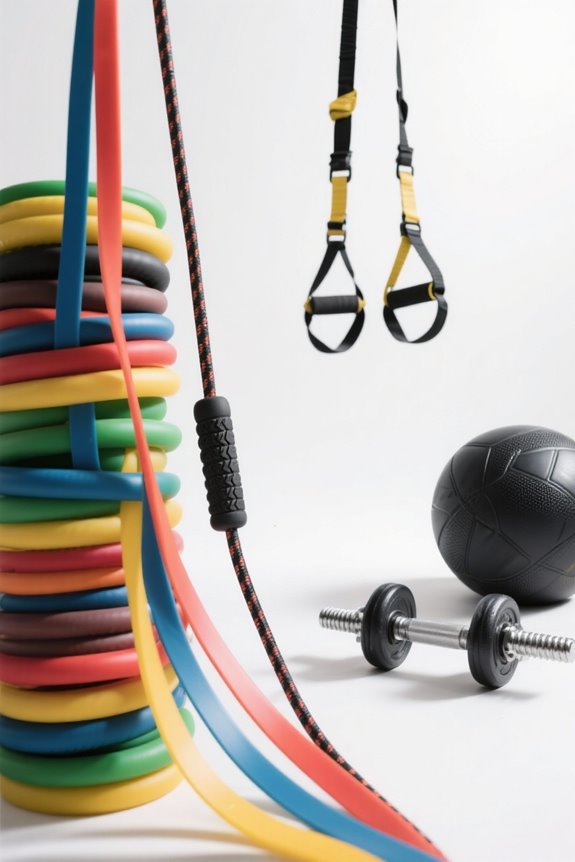
Adding dynamic conditioning movements to training circuits considerably enhances overall fitness. These exercises, which include plyometric jumps and medicine ball throws, help to improve cardiovascular endurance by keeping heart rates elevated with minimal rest periods. Furthermore, dynamic conditioning enhances muscular power, promoting explosive strength necessary for various sports. This approach incorporates sport-specific patterns, which not only enhance performance but also support injury prevention through improved functional movement. In addition, dynamic conditioning increases range of motion, actively preparing muscles and connective tissues, which reduces the risk of injury during workouts. To implement these movements, trainers can use basic equipment, such as medicine balls and resistance bands, ensuring that participants remain engaged while effectively targeting multiple energy systems for peak fitness outcomes. Additionally, incorporating speed resistance bands can improve explosive power, contributing to overall athletic performance improvement over time.
Incorporating Unilateral Exercises for Balance

Incorporating unilateral exercises into training circuits serves to considerably enhance balance and stability, as these movements inherently require the activation of stabilizer muscles throughout the body. Unilateral training engages muscles like the gluteus medius, ankles, and calves, ensuring constant body stabilization. Compared to bilateral movements, single-leg or single-arm exercises pose a greater challenge, effectively improving postural control and function. These unilateral benefits translate well into daily activities, such as running or sports requiring single-leg strength. Furthermore, research shows that unilateral training can aid in correcting muscle imbalances, reducing injury risks, and potentially increasing performance through better force transfer during bilateral lifts. Consequently, incorporating unilateral training into circuits is essential for enhancing stability and overall athletic capability. Additionally, using agility ladders as part of your training circuit can further develop coordination and speed, complementing the benefits of unilateral exercises.
Designing an Efficient Circuit Format

Designing an efficient circuit format requires strategic planning to optimize participant engagement and effectiveness. The circuit flow should minimize downtime and allow for smooth shifts between stations. A typical circuit duration ranges from 10 to 45 minutes, accommodating various fitness goals. Organizing 4 to 9 stations facilitates variety while targeting multiple muscle groups, ensuring thorough workouts. The station arrangement must be logical, placing exercises that alternate between cardio and strength to engage different energy systems effectively. Each station should ideally have a work interval of 20 seconds to 1 minute, paired with 15 to 30 seconds of shift time. This setup allows for partial recovery, reduces fatigue accumulation, and enhances participant motivation through concise and focused sessions. Incorporating agility training equipment can further enhance the effectiveness of your circuit by improving coordination and speed.
Timing and Work-to-Rest Ratios
The timing and work-to-rest ratios in circuit training play a crucial role in determining the effectiveness of a workout. Aerobic circuits typically employ a 1:1 work-to-rest ratio, where work and recovery periods are equal. This approach produces ideal intervals for cardiovascular conditioning. Conversely, anaerobic circuits, such as HIIT, utilize shorter work periods of 15-45 seconds, paired with rest periods lasting 30-120 seconds, achieving ratios of 1:2 to 1:3. Such ratios target metabolic conditioning and excess post-exercise oxygen consumption (EPOC). Longer rest enhances recovery and performance sustainability, while precise ratios align with specific training frequencies and goals. Therefore, matching exercise intensity with appropriate work-to-rest ratios is essential for maximizing training effectiveness.
Utilizing Basic Equipment for Variety
Utilizing basic equipment in circuit training adds significant variety and can enhance overall workout effectiveness. Resistance bands, for instance, provide resistance variation throughout movements, promoting greater muscle activation and endurance. These bands come in various tension levels, allowing custom workout intensity tailored to individual needs. Dumbbells also serve as versatile strength tools, targeting major muscle groups with minimal maintenance, making them suitable for diverse skill levels. Compact cardio machines, such as stationary bikes and rowing machines, improve aerobic fitness alongside strength work, enriching circuit training diversity. Additionally, integrating plyometric equipment like jump ropes and plyo boxes enhances explosiveness and agility, contributing to dynamic muscle endurance. This multifaceted approach maximizes engagement and effectiveness in training circuits. Moreover, incorporating Resistance bands can significantly improve warm-up routines by enhancing blood flow and flexibility.
Programming for Balanced Muscle Engagement
Creating a well-rounded circuit training program requires careful attention to balanced muscle engagement, which helps prevent injuries while promoting effective strength development. To achieve muscle symmetry, it is important to balance push and pull exercises, ensuring joint health. Incorporating both upper and lower body exercises within the circuit helps avoid muscle imbalances. Utilizing full range of motion in each exercise promotes flexibility and recruits maximum muscle fibers for improved activation patterns. Alternating agonist and antagonist muscle groups supports even muscle engagement during recovery intervals. Including core stabilization exercises throughout the circuit enhances overall posture and force transfer. By employing these principles of balanced strength programming, trainers can effectively design circuits that foster well-rounded muscle development and minimize the risk of injury. Additionally, monitoring pressure points during circuit training can enhance comfort and prevent injuries.
Strategies for Progression and Adaptation
Enhancing strength and endurance necessitates effective strategies for progression and adaptation within training circuits. Implementing progressive overload is essential; this involves gradually increasing the weight used, number of repetitions, or overall training volume to stimulate improvement. Additionally, trainees can enhance muscular endurance by increasing repetitions or adding extra sets without immediately increasing load. Adjusting exercise tempo and reducing rest periods can also heighten muscular engagement and improve workout density. Furthermore, introducing varying exercises targeting the same muscle groups can aid in preventing training plateaus. Systematic increases in training frequency and density promote recovery while maximizing workout efficiency. Tracking these increments independently guarantees that recovery remains a priority, maintaining peak performance and adaptation over time. Moreover, incorporating adjustable angles in training equipment can further enhance skill development and adaptability in workout routines.
Ensuring Safety and Proper Form
Ensuring safety and proper form during training circuits is essential for preventing injuries and maximizing workout effectiveness. Exercisers should take safety precautions by choosing a well-ventilated, well-lit workout area, free from hazards like loose rugs and furniture. They must wear loose clothing and appropriate footwear while inspecting equipment for damage before each use. Emphasizing proper technique is vital; individuals should focus on maintaining safe movement patterns rather than rushing through exercises. Utilizing mirrors or recording workouts can aid in self-monitoring for correct form. Additionally, modifications may be necessary to align exercises with personal fitness levels, and attention must be given to signs of fatigue, preventing the risk of overexertion and injury. Having a sports first aid kit on hand can further enhance safety during workouts by preparing for potential injuries.
Recovery and Maintenance for Optimal Results
Recovery serves as an essential component in the journey toward ideal fitness results, particularly following intense training circuits. Effective recovery techniques include scheduled rest days, typically every 7 to 10 days, to allow muscle repair and growth. Athletes may require up to two rest days per week, depending on their training volume. Employing periods of active recovery within circuits, such as low-intensity movements, aids muscle recovery while maintaining cardiovascular fitness. Utilizing appropriate work-to-recovery ratios, like 1:2 or 1:3, can optimize performance. Monitoring physiological metrics, such as heart rate variability and resting heart rate, offers insights into recovery status. Proper implementation of these rest strategies minimizes the risk of injuries and overtraining, enhancing overall training outcomes. Additionally, incorporating durability factors from your training equipment can significantly impact your recovery and performance levels.
Frequently Asked Questions
How Often Should I Change My Circuit Routine?
“Variety is the spice of life.” To maintain training frequency and progress, beginners should change their circuit routine every 8-12 weeks, while intermediates and advanced trainees should update routines every 6-8 and 4-6 weeks, respectively.
What Dietary Changes Support Circuit Training?
Dietary guidelines for circuit training emphasize proper nutrition timing, including adequate carbohydrate intake pre- and post-workout, sufficient protein for recovery, and healthy fats to maintain energy levels—all essential for optimizing performance and recovery.
Can I Combine Circuits With Other Training Styles?
Circuit combinations with various training styles enhance overall fitness, juxtaposing the intensity of HIIT with the steadiness of traditional cardio. These integrations promote diverse muscle engagement, preventing monotony, while improving endurance and strength in a time-efficient manner.
What Injuries Should I Be Cautious of While Training?
While training, one should be cautious of common injuries such as muscle strains, sprains, and tendonitis. Implementing preventative measures like proper warm-ups, gradual progression, and attentive technique can greatly reduce the risk of these injuries.
How Can I Measure My Progress Effectively?
To measure progress effectively, individuals should implement progress tracking methods, utilize workout metrics, observe fitness improvements, record body measurements, and assess overall well-being, ensuring a thorough understanding of their fitness journey and advancements.