As an Amazon Associate, we earn from qualifying purchases. Some links on this site are affiliate links at no extra cost to you. Our recommendations are based on thorough research and editorial judgment.


What Makes Resistance Bands Effective For Soccer Training?

Resistance bands are effective for soccer training due to their ability to enhance strength, speed, agility, and coordination. They provide variable tension, optimizing resistance throughout movements, which improves key muscle activation in hips, glutes, and core. Research shows that an 8-week resistance band program can considerably improve sprinting times. Additionally, bands help prevent injuries by offering controlled resistance that stabilizes joints. Their portability and affordability make them accessible for athletes at all levels, promoting consistent training growth. Discover more about their benefits.
Key Takeaways
- Resistance bands provide variable tension, optimizing resistance throughout the full range of motion for enhanced strength development in soccer players.
- They significantly improve speed and agility by enhancing muscle activation during sprinting and facilitating efficient training in a short timeframe.
- Band training promotes better neuromuscular coordination and balance, crucial for executing complex soccer movements accurately.
- They help prevent injuries by stabilizing joints and reducing stress on vulnerable areas, essential for maintaining long-term athlete health.
- Resistance bands are practical and accessible, allowing training in various environments with minimal storage and cost requirements.
Strength and Power Enhancement
Resistance bands serve as effective tools for enhancing strength and power in soccer training. These bands generate variable tension, optimizing resistance efficiency throughout the entire range of motion. By isolating key muscle groups such as the hips, glutes, and core, they help develop essential strength required for soccer performance. Progressive overload is achievable by adjusting band resistance, fostering explosive adaptation and muscle hypertrophy. Research indicates that resistance band training can improve one-rep max squat strength by over 30% in soccer players within six weeks. Additionally, the unique eccentric and concentric loading promotes thorough muscle strengthening, which further decreases the risk of injury. Overall, resistance bands greatly enhance players’ power and strength, contributing to improved performance on the field. Moreover, the key factors to consider when selecting resistance bands can maximize training effectiveness and ensure durability.
Speed and Agility Improvement

Effective training methods can notably enhance speed and agility in soccer players, with resistance bands playing an essential role in this development. Research indicates that an 8-week training program utilizing resistance bands greatly improved the 30-meter sprint times of U13 youth soccer players. Experimental groups employing these bands exhibited statistically significant performance gains over control groups (*p* < .05; ES = 0.568–3.531). The continuous elastic tension provided by the bands enhances muscle activation during sprinting, facilitating improved acceleration and transfer of speed to game situations. Additionally, the resistance variety of band training optimizes performance in a short timeframe, making it an efficient choice for in-season practice. Consequently, resistance band exercises effectively contribute to a soccer player’s speed and agility development. Incorporating compression socks into training can further enhance muscle support and recovery during rigorous practice sessions.
Neuromuscular and Coordination Benefits

Numerous benefits arise from incorporating resistance bands into soccer training, particularly concerning neuromuscular and coordination enhancements. Resistance band exercises improve muscle activation and motor control, which are essential for executing soccer skills like passing and shooting effectively. The bands facilitate maximal muscle fiber engagement without requiring heavy loads, promoting neuromuscular pathway activation safely. Regular training with bands enhances balance enhancement, both static and dynamic, leading to improved stability during gameplay. This training also sharpens body awareness and control, refining the execution of soccer techniques during multidirectional movements. Enhanced coordination through resistance bands reduces faulty movement patterns, promoting smoother motor execution and overall efficiency. Consequently, players can perform complex tasks with greater proficiency during competitive play. Additionally, using equipment like adjustable agility training poles can further enhance footwork and coordination, complementing resistance band exercises effectively.
Injury Prevention and Rehabilitation

The incorporation of resistance bands into soccer training will considerably enhance both injury prevention and rehabilitation strategies. These bands provide a controlled load application that reduces stress on joints, mitigating the risk of overuse injuries during rehab. By enhancing joint stability, resistance bands improve muscle activation around vulnerable areas, such as the knees and ankles. This targeted activation helps correct muscular imbalances linked to injury risk, fostering safer dynamics during play. Additionally, bands facilitate tailored rehab strategies, allowing for gradual strength rebuilding without overloading healing tissues. Enhanced proprioception from band training also contributes to joint stability, promoting better coordination during high-impact maneuvers. Consequently, resistance bands are a valuable tool for reducing injury risk and enhancing recovery outcomes for soccer players. Integrating mid-cut soccer cleats into training regimens can further support ankle stability and performance on the field.
Practicality and Accessibility in Training
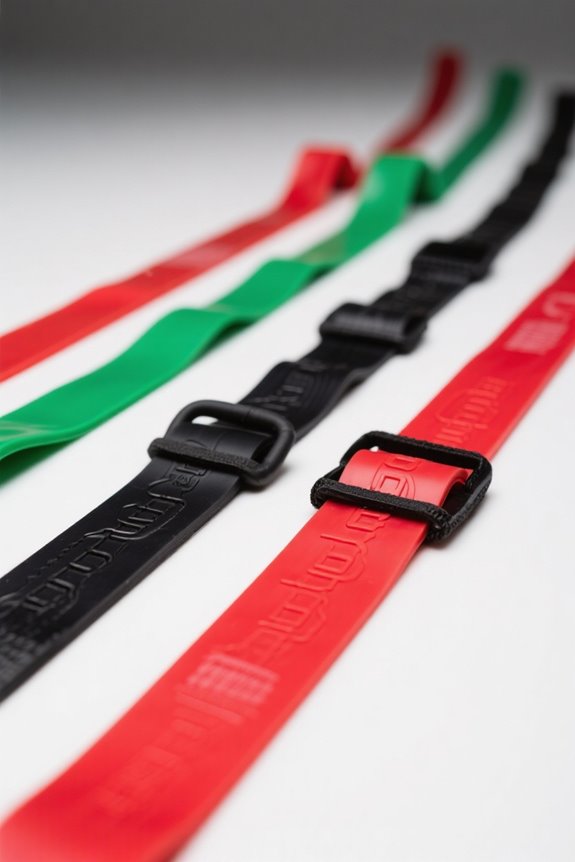
Resistance bands represent a practical solution for soccer training, offering benefits of portability and space efficiency that traditional equipment cannot match. Their lightweight and compact design permits easy transport, enabling training across various environments, including home, field, or gym. This adaptability caters to individual preferences, allowing players to engage in effective workouts even in confined spaces. Additionally, the minimal storage requirements facilitate seamless integration into training routines, especially during off-season or travel when traditional gyms are unavailable. Resistance bands also provide an affordable option for teams and individual athletes, ensuring accessibility to all skill levels. This cost-effectiveness and accessibility support consistent training schedules, enhancing the overall development of players, regardless of their training environments. Furthermore, incorporating various components like resistance tools can optimize workouts and improve athletic performance.
Frequently Asked Questions
How Do Resistance Bands Compare to Free Weights in Effectiveness?
Resistance bands provide progressive overload and enhance injury prevention through controlled movements, whereas free weights demand careful supervision due to injury risks. Both methods yield similar strength gains but differ in functionality and adaptability to training environments.
Can Resistance Bands Be Used for Upper Body Training in Soccer?
Like a sculptor shaping a statue, resistance bands can effectively enhance upper body strength, essential for soccer performance. They enable targeted training, improve muscle coordination, and reduce injury risk, benefiting players at various skill levels.
What Age Group Benefits Most From Resistance Band Training?
Youth athletes, particularly those aged 13 to 18, benefit most from resistance band training. Their age appropriateness enhances explosive power, speed, and agility while ensuring safety during growth spurts, promoting effective and injury-free athletic development.
Are There Any Specific Exercises for Resistance Band Training in Soccer?
What exercises enhance soccer performance? Resistance band training includes banded sprints, lateral shuffles, and dynamic core drills, all designed to build strength, agility, and stability, ultimately improving players’ on-field skills and game readiness.
How Long Should Resistance Band Training Sessions Last for Optimal Results?
Resistance band training sessions should last between 10 to 30 minutes, emphasizing training intensity through short bursts of 12 to 15 seconds, followed by maintenance intervals of 40 to 90 seconds for ideal results in soccer conditioning.