As an Amazon Associate, we earn from qualifying purchases. Some links on this site are affiliate links at no extra cost to you. Our recommendations are based on thorough research and editorial judgment.


Why Are Agility Poles Essential For Dribbling Development?

Agility poles are essential for dribbling development in soccer as they enhance coordination, balance, and spatial awareness. These poles facilitate targeted drills that improve motor control and footwork. By challenging players with rapid direction changes, agility poles promote neuromuscular responsiveness, vital for effective dribbling under pressure. Regular practice increases cognitive skills, allowing for faster decision-making during games. Additionally, training with agility poles reduces injury risk, creating a safer environment for skill advancement. More insights on specific applications await.
Key Takeaways
- Agility poles enhance coordination and muscle synchronization, crucial for maintaining control while dribbling under pressure.
- Drills with agility poles improve foot skills for both dominant and non-dominant feet, fostering better dribbling versatility.
- Utilizing agility poles develops dynamic balance, allowing players to make sharp cuts without losing control of the ball.
- Regular training with agility poles sharpens cognitive-motor integration, leading to quicker decision-making during dribbling.
- Practicing with agility poles strengthens lower limbs, enhancing overall stability and reducing injury risk during fast-paced dribbling situations.
The Role of Agility in Soccer Performance
Agility plays a pivotal role in soccer performance, as it enables players to respond swiftly to dynamic game situations. According to agility measurements, midfielders exhibit the fastest agility, outperforming goalkeepers and defenders. Strikers and forwards demonstrate quicker agility than goalkeepers, but midfielders often achieve the highest overall agility performance. The nature of soccer involves frequent rapid direction changes in confined spaces, making agility essential. Regularly measuring agility can guide coaches in tailoring training to specific positional needs. By focusing on agility performance, players enhance their capability to maneuver effectively during matches. Consequently, targeted agility training can lead to significant improvements, helping players maintain a competitive edge in their roles within the team. Incorporating soccer agility training equipment into practice sessions can further amplify these agility gains.
Understanding Dribbling Skill Dynamics
Dribbling skill dynamics encompass a variety of physical and cognitive elements that interact to shape a player’s ability to navigate through opponents effectively. Successful dribbling involves control, deception, and the ability to make quick decisions under defensive pressure. Dribbling psychology plays an essential role; a player’s perceived competence can influence their performance, particularly during high-pressure situations. Real-time decision-making speed is vital—players must assess defender movements and choose ideal paths effectively. Studies show that a player’s balance and body orientation notably impact their success in one-on-one situations. Additionally, advanced tracking technology improves the understanding of these dynamics, as it can quantify player actions and highlight the importance of specific factors, such as aggressiveness and speed, within dribbling maneuvers. Regular use of agility ladder training has been shown to enhance coordination and foot speed, which are critical for effective dribbling.
Benefits of Agility Training for Soccer Players

While various training techniques exist, incorporating agility training into a soccer player’s routine provides significant benefits that enhance overall performance. Agility techniques improve sprint speed and change-of-direction ability, essential for dynamic play. Studies show moderate effect sizes, ranging from 0.35 to 0.72, indicating improvements in these areas among adolescent players. Additionally, agility drills foster enhanced cognitive function, leading to faster decision-making and improved anticipatory skills on the field. This training reduces injury risk by boosting balance and coordination, strengthening lower limbs. Finally, agility training fosters player motivation through progress and tangible results. By developing these vital skills, soccer players can perform at higher levels during competition, enhancing overall effectiveness in their respective positions. Moreover, incorporating adjustable angles in training routines can further tailor exercises to simulate real match conditions and improve specific skills.
How Agility Poles Enhance Coordination

Enhancing coordination is essential for any soccer player’s performance, and agility poles serve as a valuable tool in achieving this goal. By necessitating simultaneous use of multiple muscle groups, agility poles promote muscle synchronization, leading to improved motor coordination. These drills enhance players’ ability to adjust body positions dynamically, pivotal in maintaining balance while executing rapid movements. Furthermore, proprioceptive training through agility poles develops athletes’ spatial awareness, enabling better judgement of distance and timing when maneuvering around opposing players. Regular practice enhances not only intermuscular coordination but also cognitive-motor integration. This results in quicker neural impulse transmissions, thereby refining players’ abilities to respond efficiently during gameplay, vital for effective dribbling under pressure and improving overall performance. Incorporating high-density construction into training with agility poles ensures durability and resilience, allowing athletes to focus on their development without distractions.
Integration of Agility Poles in Dribbling Drills

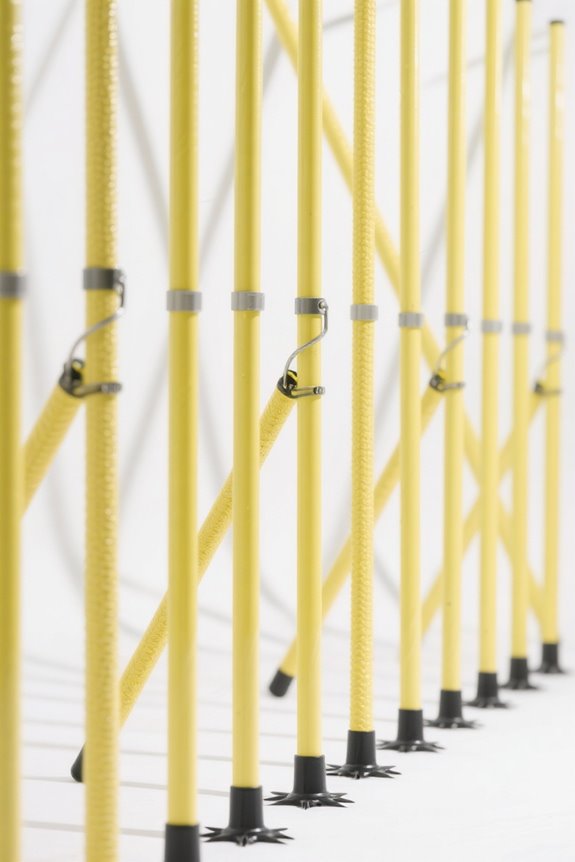
Agility poles serve as an essential component in the design of effective dribbling drills, enabling players to refine their ball control and spatial awareness. Incorporating agility poles into dribbling drills facilitates precise footwork as players navigate through confined spaces, promoting quicker reactions to simulate game scenarios. This method develops both dominant and non-dominant foot skills, enhancing ambidextrous ball handling and improving overall control. Additionally, agility poles allow players to practice tactical maneuvers, such as exploiting gaps and executing feints to evade defenders. By integrating poles with various drill setups, including adjustable spacing, trainers can tailor drills to individual skill levels while enhancing players’ neuromuscular coordination, ultimately leading to improved performance during competitive matches. Furthermore, moisture control features in athletic gear can significantly enhance comfort during these drills, allowing players to focus on skill development without distraction.
Speed and Change of Direction in Dribbling
Speed and change of direction (COD) play critical roles in effective dribbling for soccer players. Enhanced speed mechanics allow players to sprint rapidly, penetrating defensive lines and creating scoring chances. Experience in agility drills has shown that such training improves sprinting ability and directly impacts dribbling performance. Efficient COD enables athletes to maneuver effectively with the ball, accelerating and decelerating swiftly. Agility poles facilitate realistic directional shifts, helping players develop muscle memory for sharp cuts and improved direction control. Training often incorporates reaction elements to simulate in-game demands and optimize cognitive processing. The combination of speed training and refined COD skills greatly contributes to an athlete’s ability to maintain ball control while outmaneuvering defenders, enhancing overall gameplay. Utilizing agility training equipment effectively can further elevate these skills and performance on the field.
Agility Drills vs. Traditional Training Methods
Effective player development in soccer often hinges on the training methods employed, particularly when comparing agility drills to traditional techniques. Agility drills, designed for rapid footwork, enhance body control and quick changes of direction, providing direct agility benefits. They also create realistic scenarios with equipment like agility poles, which improves game-related skills. In contrast, traditional training methods often focus on fundamental techniques without simulating game conditions. This reliance limits the effectiveness of skills retention as isolated drills tend to lack real-time engagement. Consequently, integrating agility drills enables players to receive immediate training feedback, encouraging quicker adjustment to movement patterns, improving both technical and tactical attributes essential for game performance. The structured approach of agility drills outperforms less dynamic traditional methods in developing effective dribbling skills. Additionally, incorporating anti-slip soccer socks can enhance stability and traction during agility drills, further supporting skill development on the field.
The Science Behind Agility Training Effects
Exploring the scientific foundations of agility training reveals its multifaceted benefits for athletes, particularly in soccer. Agility training enhances muscle strength, flexibility, and balance, all essential for peak performance. Furthermore, it fosters neural adaptation by improving motor unit recruitment and coordination between brain regions, thereby enhancing overall training efficiency. This training improves endurance and increases VO2 max levels, supporting athletes in sustaining high-intensity efforts. Additionally, effective agility training practices, such as plyometrics and change-of-direction exercises, can lead to measurable performance improvements within six weeks. With enhanced proprioceptive feedback, athletes can execute movements more efficiently and respond to dynamic game situations with greater agility, reinforcing the link between tailored agility exercises and elite sports performance. Comprehensive agility equipment sets provide a versatile approach to training, allowing athletes to focus on specific skills and drills.
Specificity of Training With Agility Poles
While traditional agility training focuses on general movement patterns, the specificity of training with agility poles offers distinct advantages in developing dribbling skills essential for soccer. Agility poles require athletes to engage in rapid, multidirectional movements that closely resemble the quick changes required during dribbling. Drills involving pole navigation, such as ladder drills and zigzag patterns, specifically target vital movements like forward, lateral, and backward motions. Research indicates that motor-cognitive agility training with poles markedly enhances football-specific dribbling performance compared to generic change-of-direction training. The training specificity provided by agility poles enhances athletes’ ability to navigate tight spaces, which translates into improved control in congested areas during matches, ultimately optimizing their dribbling efficacy when faced with real-game challenges. Additionally, incorporating equipment like agility ladders can further complement these drills by enhancing speed and coordination.
Incorporating Neuromuscular Elements
Incorporating neuromuscular elements into training with agility poles greatly enhances an athlete’s dribbling skills in soccer. The use of agility poles stimulates proprioceptive feedback, requiring precise foot placement and body positioning during drills. Such drills improve kinesthetic awareness, enabling athletes to sense limb position without visual cues due to neuromuscular adaptation. This enhanced proprioception facilitates quicker, more fluid dribbling and sharper directional changes on the field. Additionally, the unpredictable movement patterns created by agility poles force rapid neuromuscular responses, simulating game scenarios. Consequently, athletes experience improved reaction times and cognitive-motor integration, which aids in faster decision-making during pressure situations. These factors collectively contribute to more effective ball control and overall performance in competitive environments. Furthermore, incorporating cone drills into training routines can further refine agility and coordination, enhancing overall skill development.
Building Dynamic Balance and Strength
Building dynamic balance and strength is fundamental for enhancing dribbling performance in soccer. Agility poles facilitate drills that challenge players to maintain dynamic stability while executing sharp cuts and rapid direction changes. These exercises improve neuromuscular control, ensuring players can balance effectively during acceleration and deceleration, thereby lowering the risk of injury. Strength progression in lower limbs results from repetitive movements associated with agility pole drills, enhancing power during explosive actions, critical for cutting and re-accelerating. Additionally, improved lower limb strength translates to better stability during sudden stops, supporting athletes in maintaining control when dribbling under pressure. Overall, agility pole training promotes essential balance and strength development, enabling players to refine their dribbling skills with greater efficiency and effectiveness.
Enhancing Cognitive Skills Through Agility Training
Agility training plays an essential role in enhancing cognitive skills, integrating physical movement with mental processes to foster improved performance on the field. This training enhances cognitive flexibility by challenging individuals to adapt to rapid changes and make quick decisions. Improved executive function is a significant benefit of agility workouts, as these exercises require simultaneous execution of physical and cognitive tasks, which optimizes overall mental processing. Agility drills also develop dual-task abilities, allowing athletes to multitask effectively, beneficial for both their physical movements and mental engagement during games. In addition, these workouts stimulate important brain regions, promoting better concentration and memory, ultimately leading to more effective decision-making capabilities and greater cognitive resilience in challenging scenarios.
Reducing Injury Risk With Targeted Agility Workouts
Targeted agility workouts play an essential role in reducing injury risk for athletes by teaching them fundamental movement techniques. These workouts enhance proper landing techniques, ensuring soft knees and hips that absorb impact, which minimizes stress on joints and subsequently reduces injuries. Balanced strength and body awareness help athletes distribute force evenly, preventing overuse injuries. Additionally, safe deceleration techniques mitigate the risk of hamstring strains and ACL tears by facilitating controlled movements. Incorporating agility drills with equipment like poles simulates game situations, improving footwork and stability. This targeted conditioning fosters better control during lateral and rapid movements, considerably enhancing injury resilience. Ultimately, integrating these agility workouts into training not only boosts performance but also safeguards athletes against common injuries.
Long-Term Advantages of Agility Pole Training
Effective training methods, such as the use of agility poles, offer numerous long-term advantages for athletes aiming to enhance their performance in sports like soccer. Agility pole training fosters long-term adaptations by improving neuromuscular coordination, which enables athletes to execute precise movements with greater efficiency. These adaptations contribute to sustainable performance, allowing players to maintain high levels of agility, speed, and explosiveness throughout their careers. Athletes who engage in regular agility exercise enhance their cognitive skills, enabling quicker decision-making and improved spatial awareness during games. Additionally, this focused training reduces energy waste, thereby increasing endurance. Ultimately, agility pole workouts provide essential benefits, including enhanced footwork precision and improved stamina, which are critical for successful dribbling and overall athleticism.
Frequently Asked Questions
How Can Agility Poles Be Used in Individual Training Sessions?
Agility poles stand like sentinels in an athlete’s training ground, guiding individual drills that enhance skills. Players navigate through these obstacles, honing footwork and ball control, ultimately fostering skill enhancement for improved performance on the field.
What Age Group Benefits Most From Agility Pole Training?
The age group benefiting most from agility pole training is early childhood to pre-adolescence, as youth training during this stage greatly enhances foundational skills, promoting effective skill enhancement in dribbling, coordination, and overall athletic development.
Are There Alternative Tools to Agility Poles for Dribbling Development?
Yes, alternatives to agility poles for dribbling development include cone drills, enhancing ball control and spatial awareness, and ladder exercises, which improve speed, coordination, and footwork, essential for effective dribbling under game-like pressure.
How Often Should Agility Pole Drills Be Practiced for Optimal Results?
Agility pole drills should be practiced 2 to 3 times per week to enhance performance. Varying drill variations within this training frequency fosters improved coordination and agility, vital for athletes aiming to excel on the field.
Can Agility Poles Be Used for Sports Other Than Soccer?
Agility poles are versatile tools applicable in sports beyond soccer, including basketball. They can enhance basketball drills and various agility drills, improving footwork, balance, and coordination, essential for athletic performance across different disciplines.